
A human-directed, AI-accelerated family Bible app concept, from research and product strategy through UX, a complete design system and an interactive prototype.
0→1 independent product concept
10 products reviewed
4 core design decisions
1 interactive prototype & design system
Development
FOUNT / 0–1 PRODUCT CONCEPT
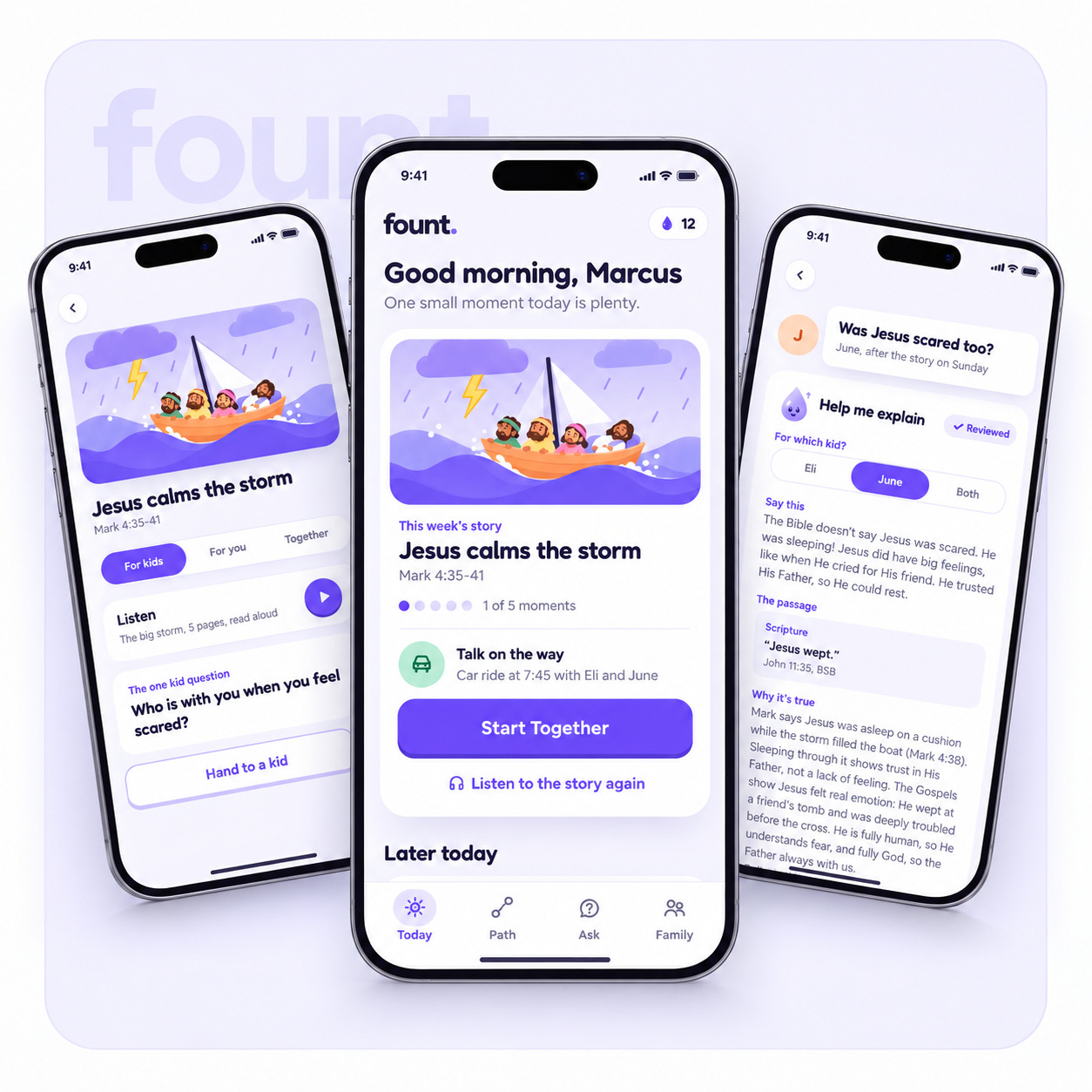
FOUNT turns Bible stories into everyday family conversations. I took the idea from discovery and product strategy through experience design, a documented design system and a clickable mobile prototype.
Role: Product design and product direction. Scope: Research, strategy, UX/UI, brand, design system and prototyping. Tools: Claude, ChatGPT and HTML. Status: Independent concept.
Parents have an abundance of Bible stories, videos and devotionals, but the moment after a child hears a story is often unsupported. Can the parent turn it into a conversation that fits real family life? I framed FOUNT around the gap between consuming faith content and practicing faith together. The product should build a parent's confidence, not create another screen-time habit.
Of churched parents surveyed, 86% said their children learn spiritual lessons at church that they couldn't teach themselves. Barna / Awana research ↗
One in four U.S. parents say they talk with their children about religion extremely or very often. Pew Research Center ↗
Just 17% of fathers surveyed said they take the lead in their children's religious learning. Pew Research Center ↗
These are published landscape findings, not FOUNT product impact metrics. The proposed solution is a hypothesis to test.
I reviewed ten products across kid-first content (including Bible App for Kids, Minno and Superbook) and parent-first resources (including Parent Cue and Gospel Project Home Edition). Kids' engagement and parent guidance often lived in separate experiences. FOUNT explores the connection between them: one story, two depths, and a shared moment that makes the parent more capable next time. This was a qualitative assessment, not a claim that no competitor exists.
I deliberately avoided designing a product that families would need forever to have meaningful conversations. At first FOUNT offers clear explanations, scripts and prompts. As parents build confidence, the experience should step back: support at first, confidence over time, less dependence.
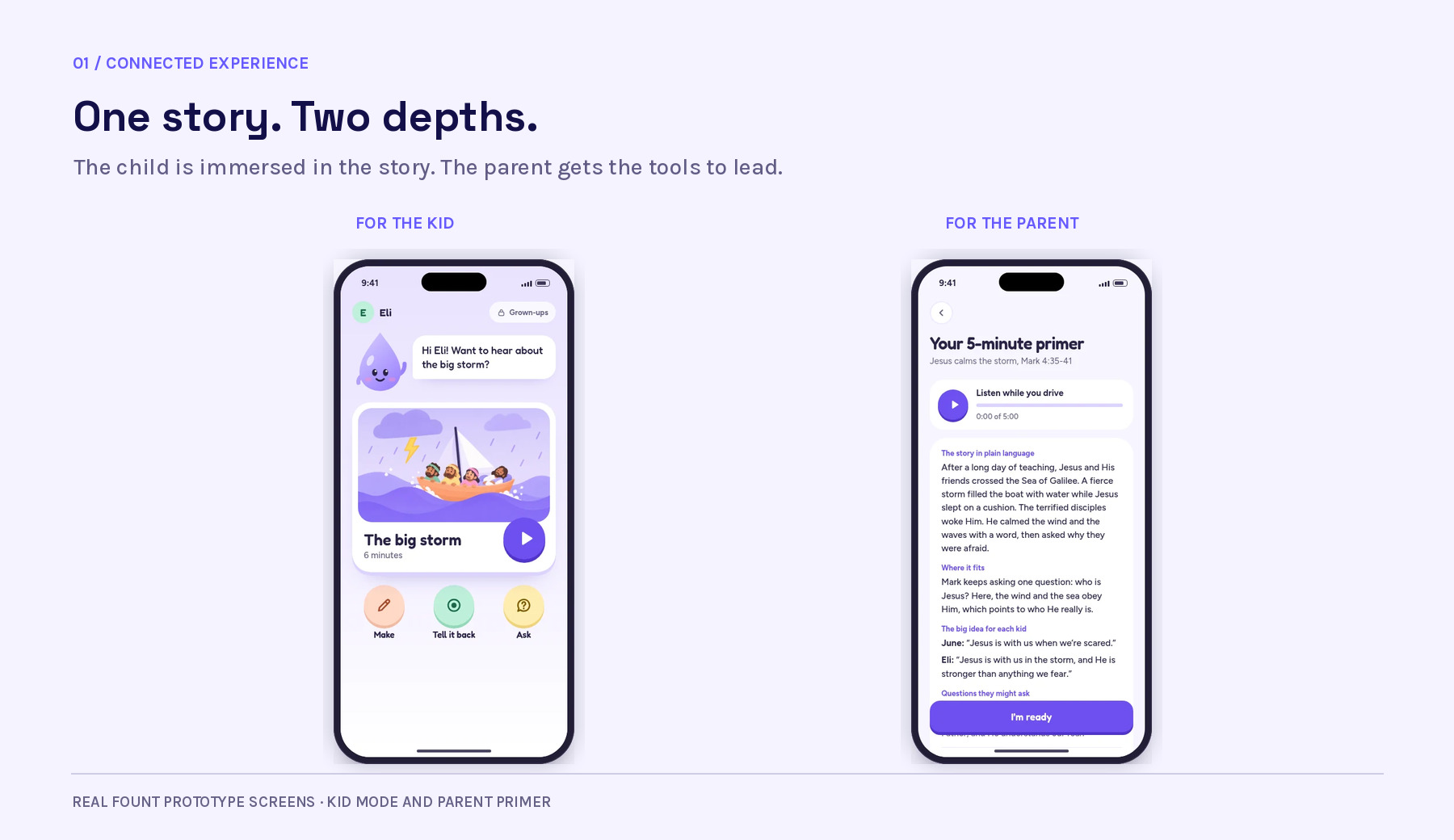
Children get an engaging, age-appropriate story. Parents get context, a short primer and questions tied to the same passage. The design tradeoff: prioritize a connected family experience over the size of the content library.
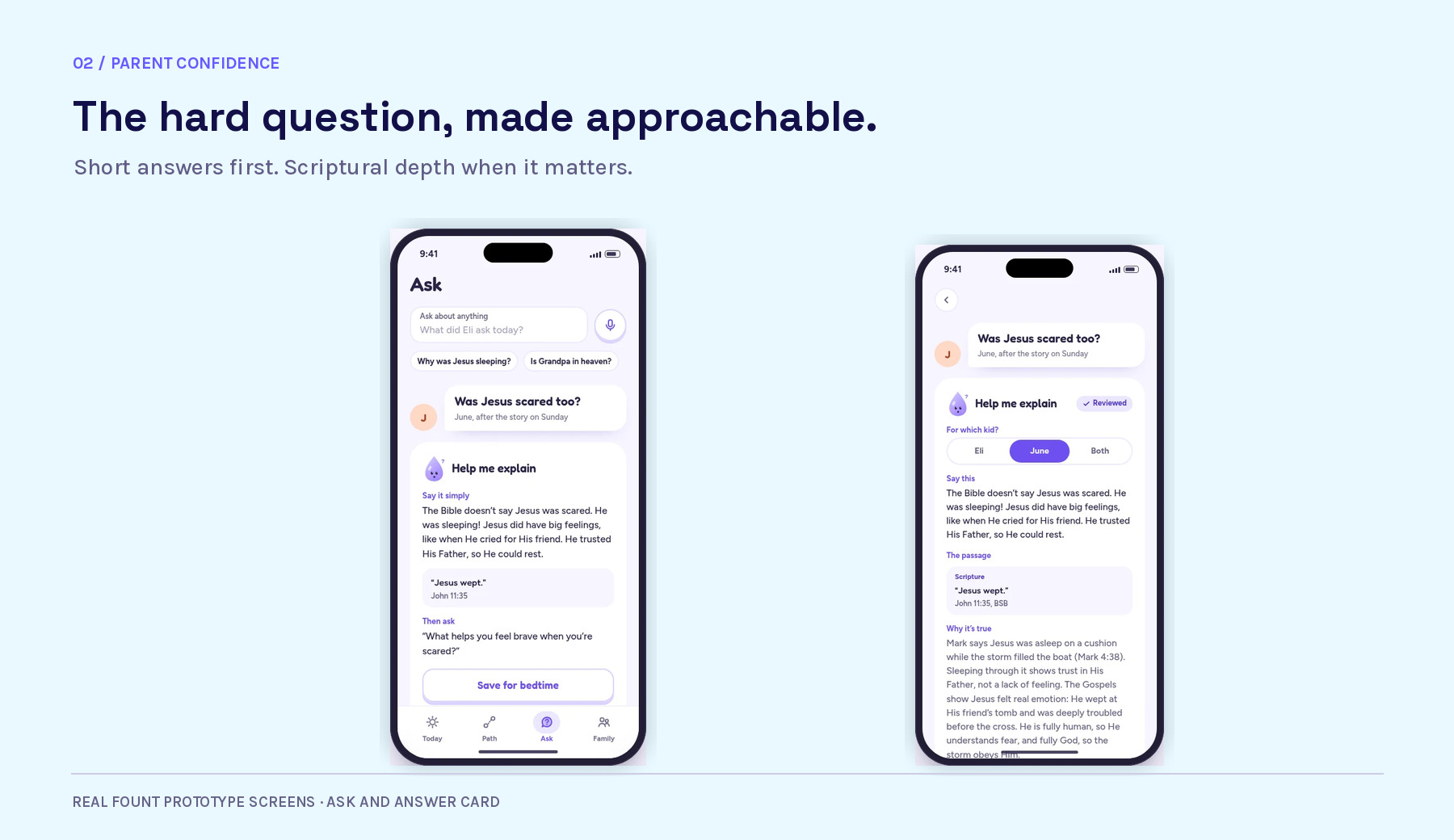
Short, age-sensitive answers supported by Scripture help parents when their child asks something unexpected. Deeper context is available when needed. The tradeoff: theological accuracy and trust over the illusion that AI always has an answer.
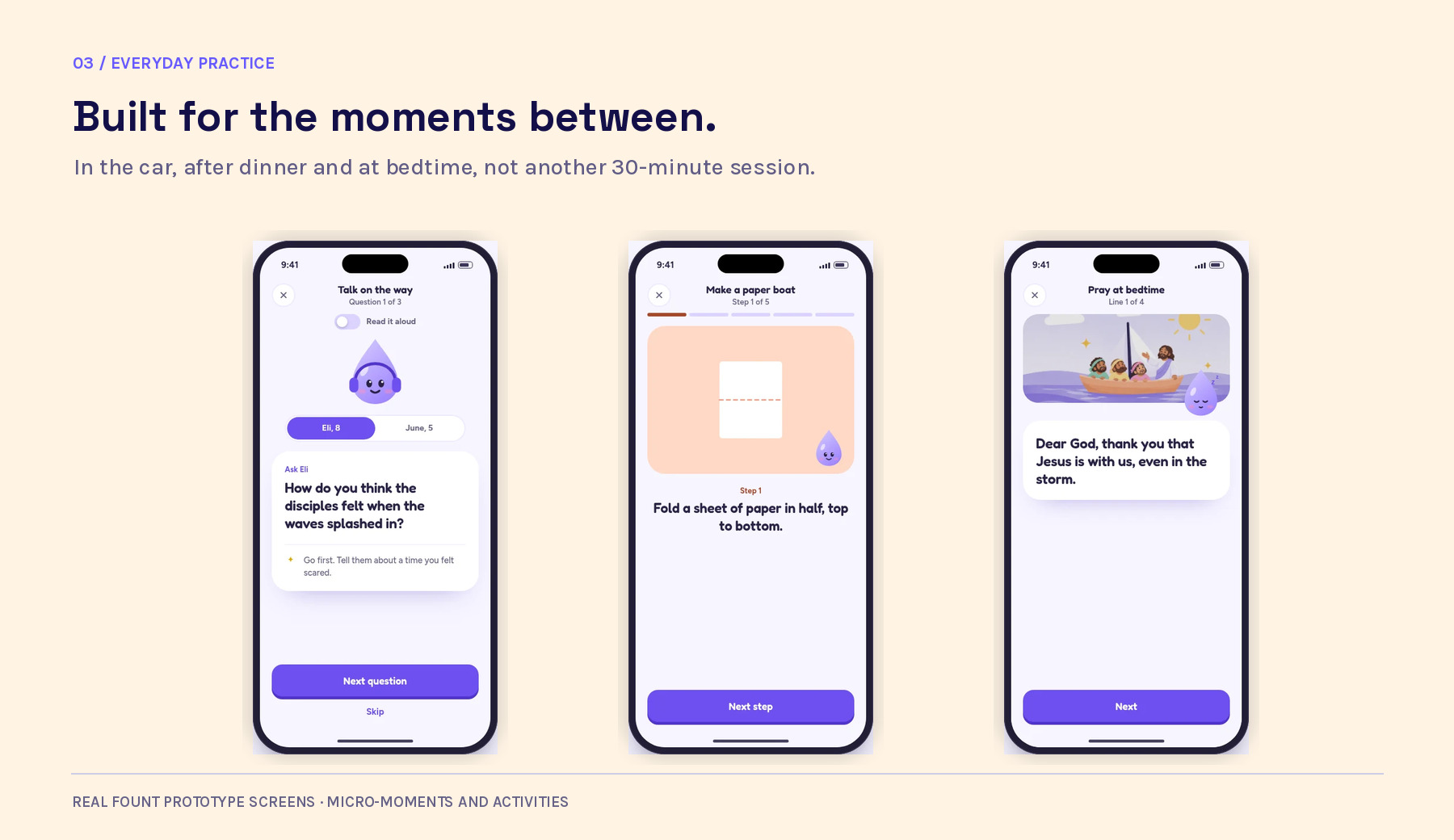
Rather than prescribing long formal devotional sessions, FOUNT breaks a weekly story into small real-world moments: a car conversation, a creative activity and a bedtime prayer. The tradeoff: brief, screen-light moments over features that keep children in the app.
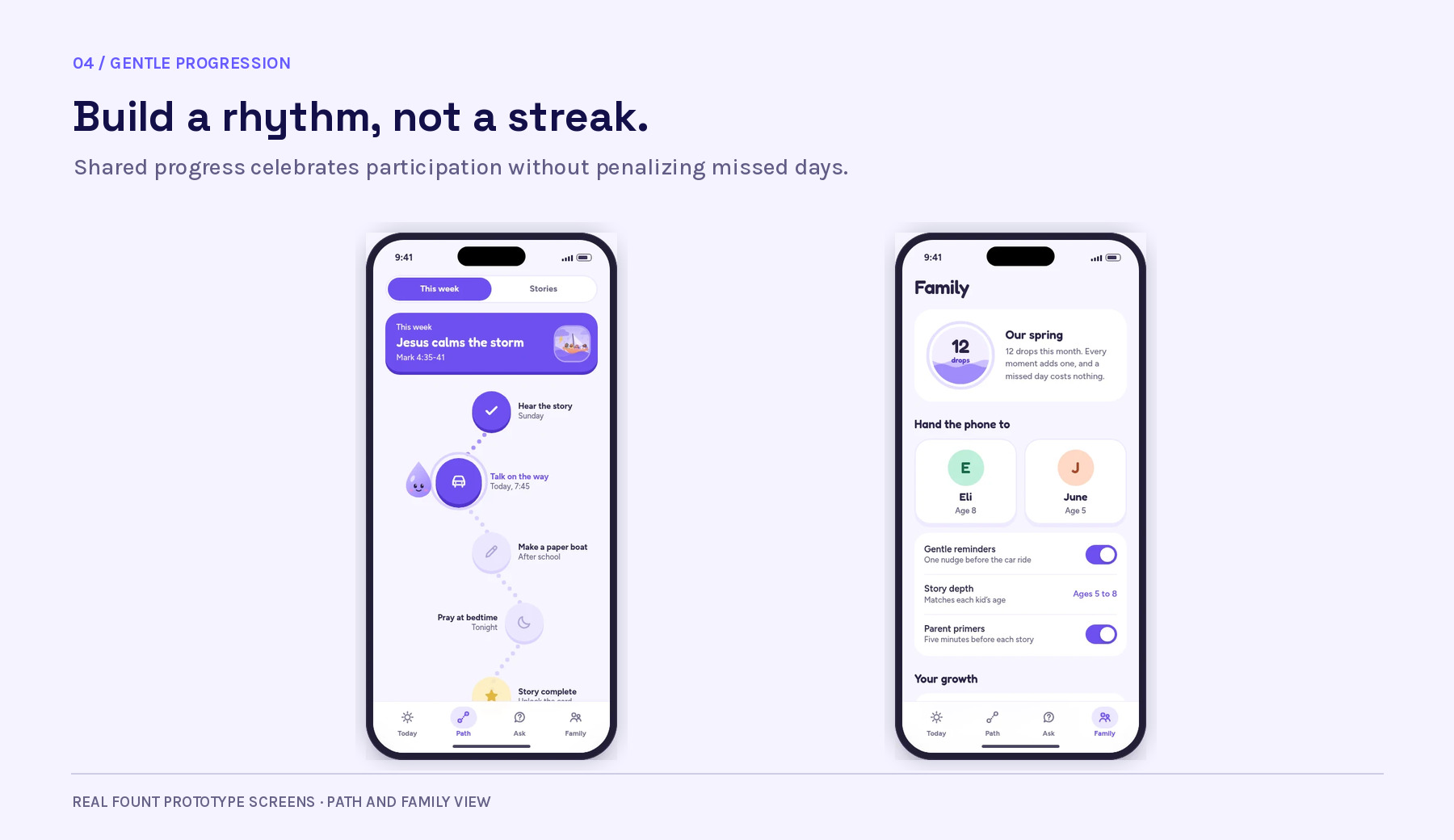
A shared family spring and gentle pathway communicate growth. Punitive streaks and broken chains would undermine the experience. The tradeoff: encouragement and easy reentry over maximizing daily app opens.
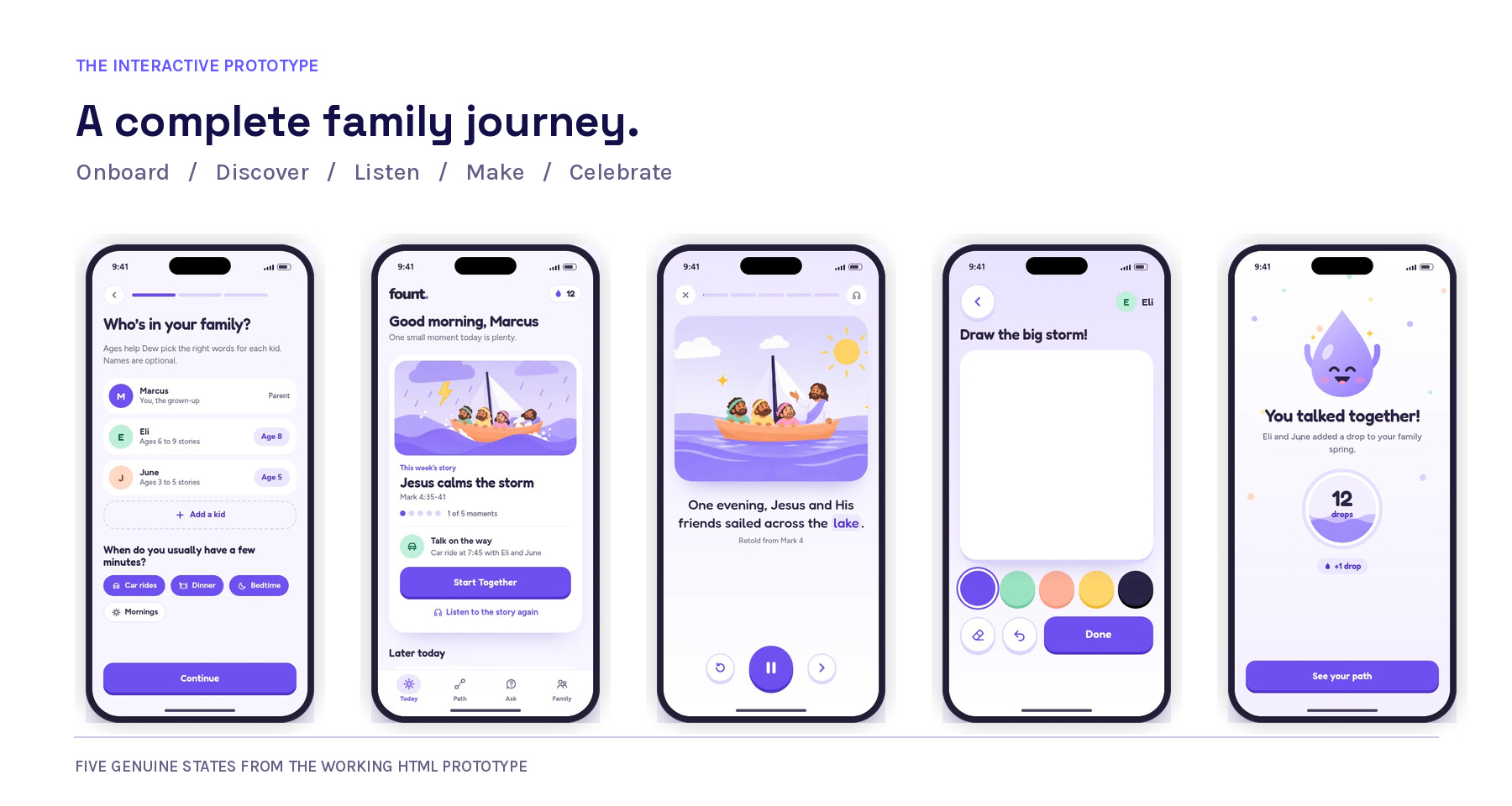
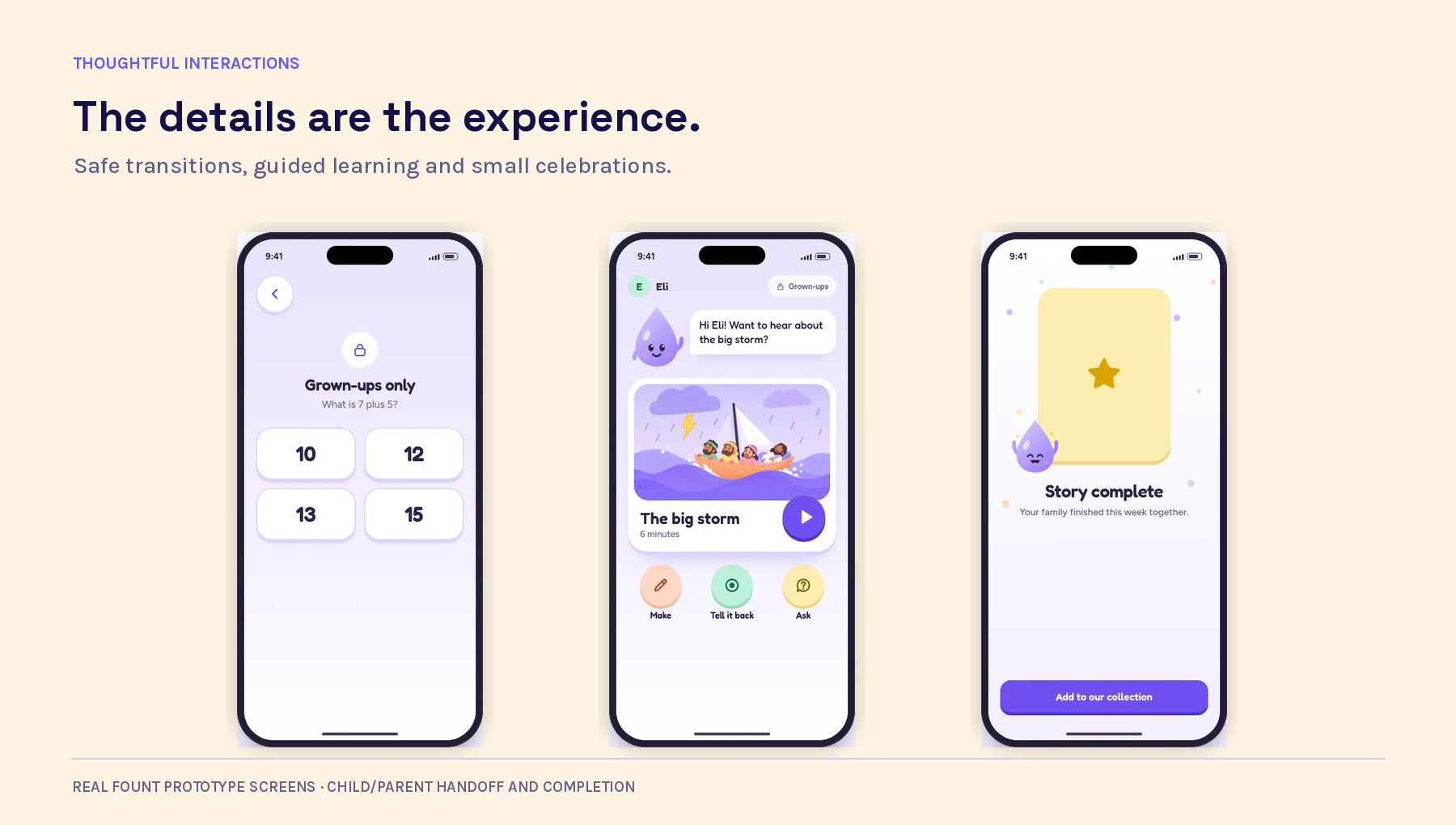
I designed the interactive journey across family setup, Today, story-player listening, kid mode, activities, parent explanations, Ask, shared progress and celebration. The HTML prototype includes key interactive states and audience transitions.
Explore the full interactive prototype ↗
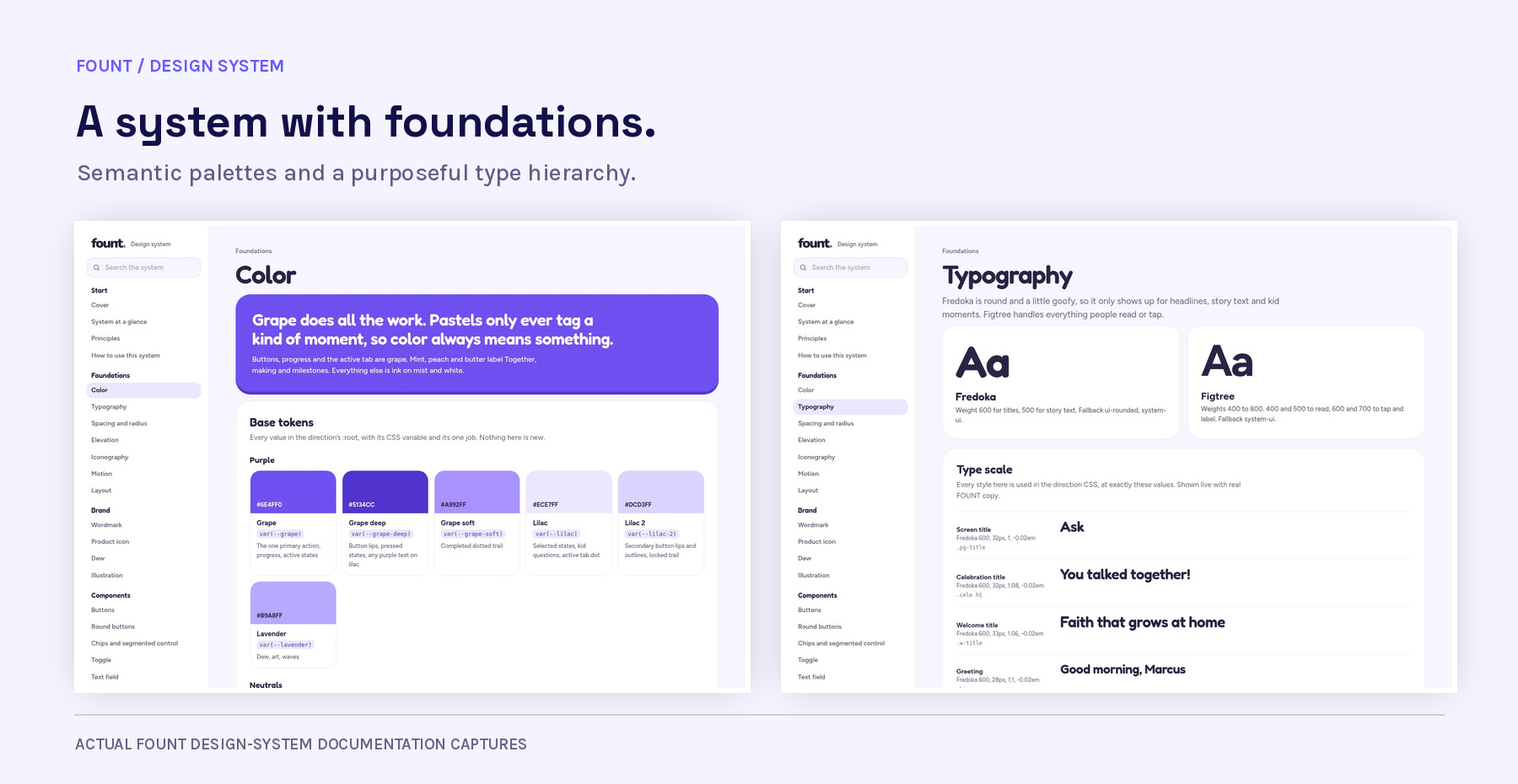
I selected and directed the Little Drops concept, then documented the system instead of leaving decisions buried inside mockups. FOUNT uses a controlled purple action color, supporting pastels, Fredoka and Figtree typography, a friendly guide named Dew, and a compact interaction vocabulary. The documentation covers semantic color, type, layout, patterns, component states, behavior and accessibility.
Explore the complete design system ↗
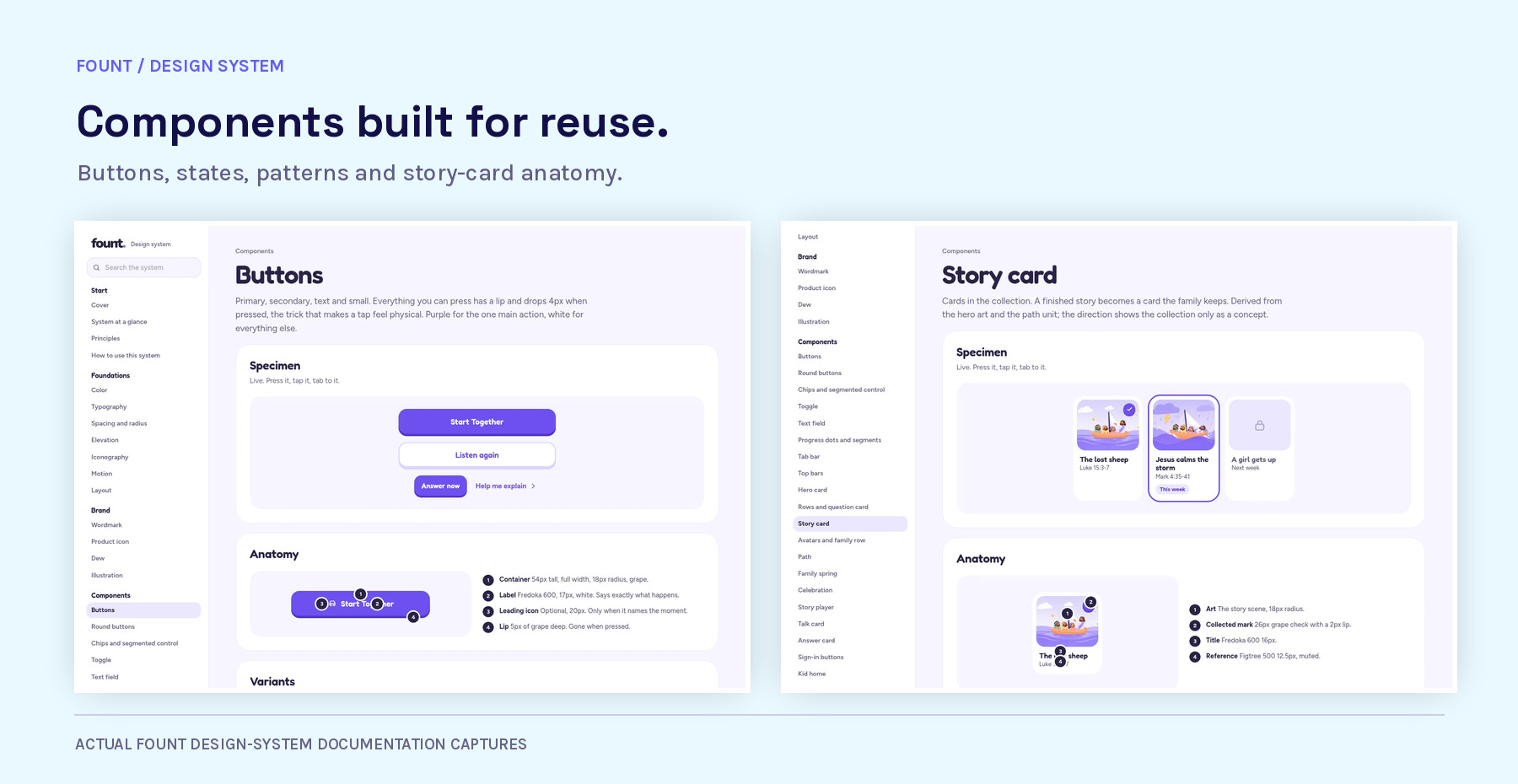
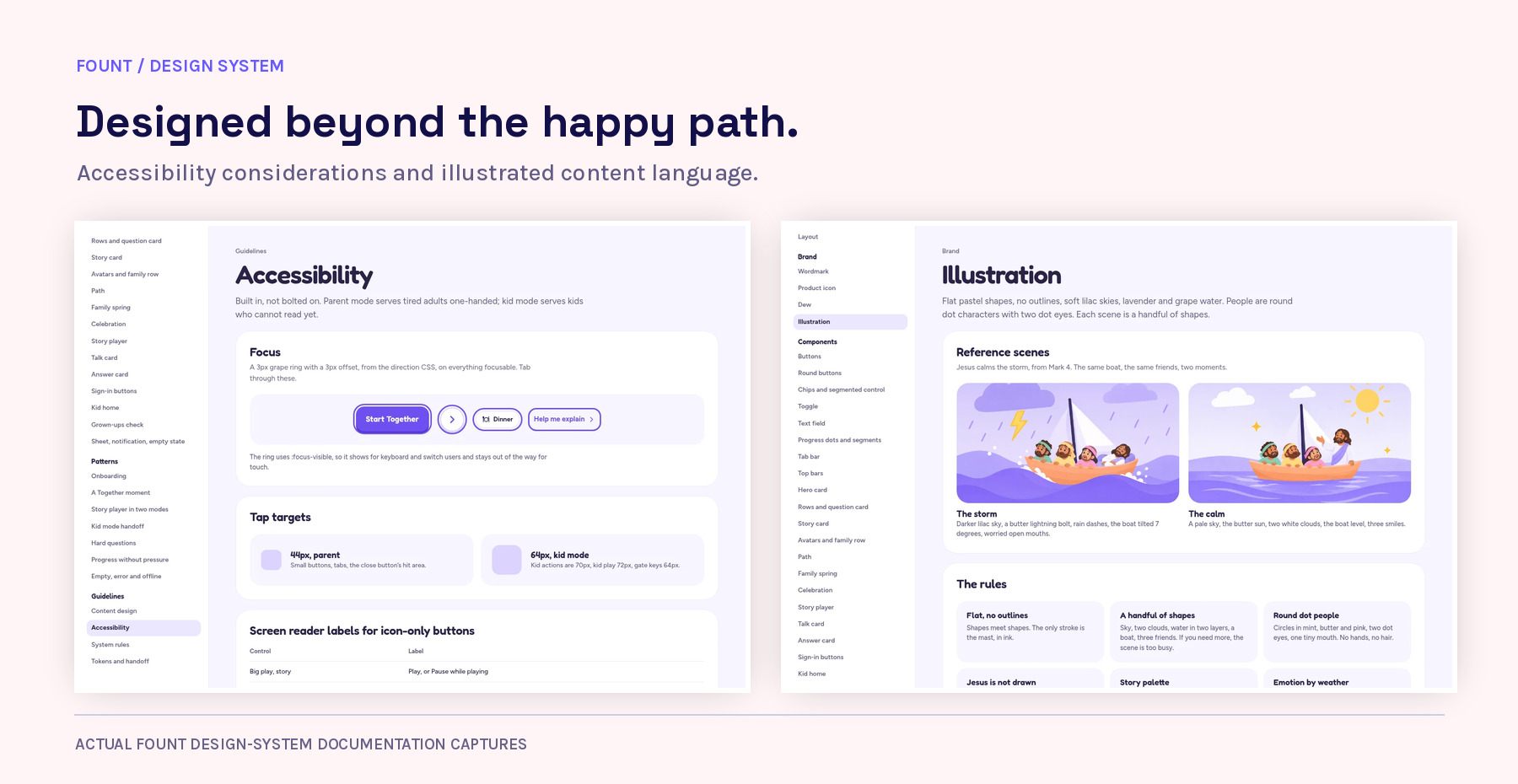
The navigable HTML prototype goes beyond static screens, covering onboarding, story progress, parent-child transitions, family flows and checks. The accompanying design-system artifact exposes reusable components and behavior across those interactions.
I used Claude and ChatGPT to accelerate research synthesis, competitive assessments, proto-personas, journey maps, IA and workflow alternatives, documentation, interface explorations and HTML prototyping. I retained creative and product ownership: defining the opportunity, setting the principles, choosing what worked, rejecting generic visual directions, pushing for better hierarchy and interaction details, and deciding what to keep, remove or revise. Generate options quickly. Judge them slowly.
FOUNT is an independent concept, not a launched product. I cannot claim product retention, revenue or parental-confidence improvements without testing. The next phase would interview parents, test the first shared activity, examine trust and accuracy in answers to difficult questions, and measure parent confidence and spontaneous conversation rather than only app usage.
That ambition shaped both FOUNT and my design process: AI extended how much I could explore and execute, but human judgment determined which problems to solve and what experience to build.
View the FOUNT prototype ↗ · View the FOUNT design system ↗
Explore the full work: Interactive FOUNT prototype ↗ · FOUNT design system ↗
